Synchronous AC alternators 1000 - 2500 kVA
Heavy project machines, including low-speed sets where the pole count, not the size, is the first constraint.
1000 - 2500 kVA · 50 Hz / 60 Hz · 4, 6 or 8 pole · Shunt/PMG
Single-bearing on an SAE flange, or double-bearing on a coupling. The two mounting arrangements
What this band covers
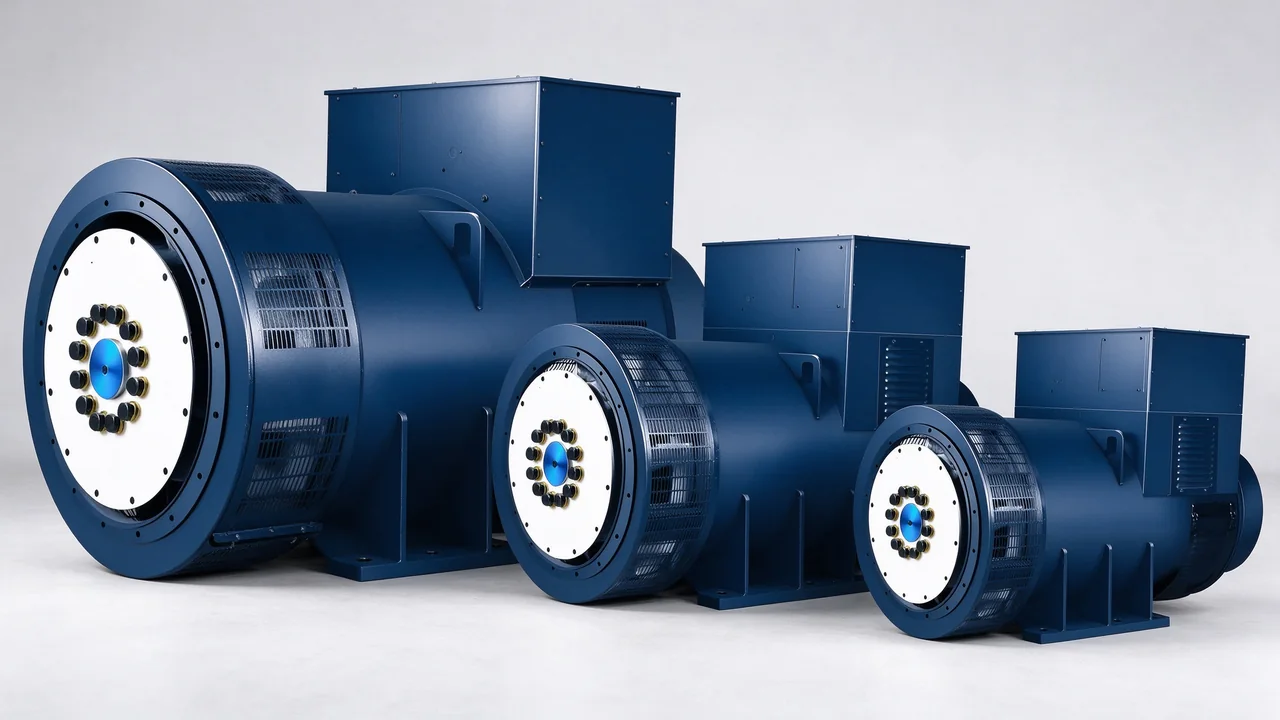
| Indicator | Parameter |
|---|---|
| Power range | 1000 - 2500 kVA |
| Frequency | 50 Hz / 60 Hz |
| Rated voltage | 50 Hz: 400/230 V, 415/240 V, 380/220 V, 220/115 V, 230 V, 115 V 60 Hz: 480/277 V, 440 V/254 V, 240 V/139 V, 208/120 V, 690/400 V, 240 V, 120 V |
| Pole count | 4, 6 or 8 pole |
| Excitation system | Shunt/PMG |
| AVR | Low-voltage PMG standard: MX341*, MX341B*; low voltage optional: digital AVR; medium voltage: digital AVR |
| Phases | Three phase |
| Connection | Star (Y) or Delta (D) |
| Insulation class | Class H |
| Protection rating | IP23 standard, IP44 or IP54 optional |
Who buys, and what to confirm before you order
Who buys
Heavy project contractors, hydro and pumping station builders, port and lifting equipment manufacturers, and power plant integrators.
What the machines are used for
Hydro and pumping duty, port cranes and lifting equipment, large continuous duty packages, and low-speed sets driven below the usual synchronous speed.
What you need to confirm before you order
- The rated output in kVA and the running load in kW, confirmed separately, and how the load behaves when it steps.
- The speed the prime mover actually runs at, and the pole count the drive can work with.
- The starting torque and the inertia the machine has to bring up, which is what a slow set really has to do.
- The cooling path and the enclosure, because a machine that runs for hours at low speed is not the same problem as one that starts and stops.
- Whether more than one machine works on the same board, and how the protection has to coordinate.
Where the configuration differs
Pole count and speed
The machine is built with the poles that produce the required frequency at the speed the drive runs at. That decision shapes the machine and cannot be changed later.
Mechanical interface
Slow prime movers are usually coupled through a gearbox or a belt, which tends to mean a double-bearing machine with an explicit coupling and alignment procedure.
Duty and excitation
Machines of this size often run continuously rather than as standby, so the rating basis and the thermal design follow the hours rather than the start-up pattern.
What affects your quote
- Power and frequencyMachine rating in kVA and load in kW confirmed separately, at 50 Hz or 60 Hz.
- Voltage and winding optionStandard winding or a special voltage, and how many different voltages the set has to carry.
- Mounting and mechanical interfaceSingle-bearing SAE or double-bearing, and how it mates to your engine and its housing.
- Excitation and short-circuit supportWhether your application needs stronger short-circuit support than the standard arrangement.
- Quantity and delivery batchUnits per order, and how many batches you want us to schedule.
- Delivery point and trade termsDestination port, and how shipping, insurance and clearance are split between us. EXW, FOB, CIF and DDP can all be quoted.
Request technical documentation
Send your requirements - a written reply within 24 hours, a selection scheme within 48.
Typical lead time and indicative budget will be confirmed in the formal quotation.
Where to go next
Mounting: single-bearing or double-bearing
The arrangement decides the flange, the bearings and the alignment. It is the one decision that cannot be changed later.
Eight application scenarios
From data centres to marine sets: the load and the conditions that decide the build in each of them.
kVA vs kW: why we ask for both
The two numbers look interchangeable and are not. The difference is what a quotation is built on.
How we inspect and ship
What is checked before the machine leaves, which documents travel with it and how the loading is planned.