Connecting the world to reliable power
Capability range
What we can supply
The range, the voltage arrangements, the connections and the excitation options available, written out so you can check them against your own requirement before you send it. Every combination is confirmed again in the formal quotation.
The table below carries what changes in each power band. The selection checklist is the version to send with your requirement.
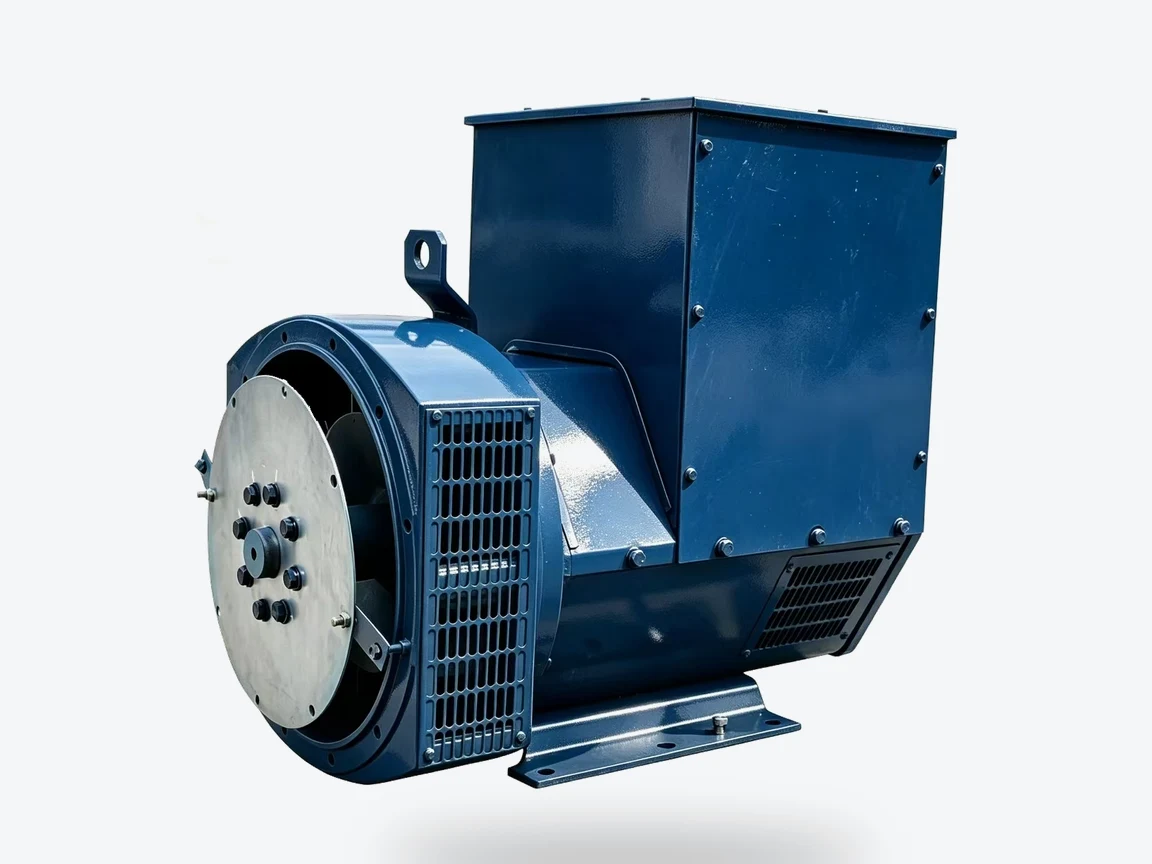
What the options mean for a machine
The alternator is the part of a genset that turns rotation into electricity. It is built against a set of conditions rather than ordered from a list: the speed the prime mover runs at, the poles that speed and the target frequency produce, the voltage arrangement, the excitation method, and the environment it has to work in.
Every combination on this page is available. Which one your project needs depends on the grid it will run on and the duty it will carry, and that is a conversation rather than a catalogue line - send the conditions and we will work through them with you.
By power band
What is available in each band
The bands are how the range is divided for selection. Each one carries the same frequency, connection and excitation; what changes between them is the size of the machine, the number of poles, and whether a single-phase machine is available.
| Dimension | 8 - 30 kVA | 30 - 100 kVA | 100 - 250 kVA | 250 - 500 kVA | 500 - 1000 kVA | 1000 - 2500 kVA |
|---|---|---|---|---|---|---|
| Frequency | 50 Hz / 60 Hz | 50 Hz / 60 Hz | 50 Hz / 60 Hz | 50 Hz / 60 Hz | 50 Hz / 60 Hz | 50 Hz / 60 Hz |
| Phases | Three phase, single phase on request | Three phase | Three phase | Three phase | Three phase | Three phase |
| Pole count | 2 or 4 pole | 4 pole | 4 pole | 4 pole | 4, 6 or 8 pole | 4, 6 or 8 pole |
| Connection | Star (Y) or Delta (D) | Star (Y) or Delta (D) | Star (Y) or Delta (D) | Star (Y) or Delta (D) | Star (Y) or Delta (D) | Star (Y) or Delta (D) |
| Excitation system | Shunt/PMG | Shunt/PMG | Shunt/PMG | Shunt/PMG | Shunt/PMG | Shunt/PMG |
Voltage
Voltage arrangements we can build
Voltage and connection are confirmed together, because they are not independent choices. These are the arrangements we can build; a site that runs on something else is quoted on its own terms rather than forced into one of these.
| Frequency | Three phase | Single phase |
|---|---|---|
| 50 Hz | 400/230 V · 415/240 V · 380/220 V | 220/115 V · 230 V · 115 V |
| 60 Hz | 480/277 V · 440 V/254 V · 240 V/139 V · 208/120 V | 240 V · 120 V |
Higher-voltage arrangements, including 690/400 V for machines from 100 - 250 kVA upwards, are quoted on request. The arrangements above are what is available; what your machine is built to is confirmed in the quotation.
Options
Protection, insulation and market access
These three are options rather than a specification. Which one applies depends on where the machine runs, what it is exposed to, and which market it is going to.
Protection
IP23, IP44 or IP54
Chosen against the site: how much dust and water the machine is exposed to.
Insulation
Class F or Class H
Chosen against the ambient temperature the machine has to work in, and how long it has to hold the load.
Market access
CE, GOST, SASO, SONCAP
The export compliance routes we work to. Which documents apply to your order, and their scope, are confirmed in the formal quotation.
We do not publish a certificate, a badge or a parameter table. The option is only the half of the answer that can be written down before the machine exists; the rest is confirmed against your order.
Price
What affects your quote
The quotation is built from the six conditions below. We do not publish a price, because a published number would be wrong for most enquiries.
- Power and frequencyMachine rating in kVA and load in kW confirmed separately, at 50 Hz or 60 Hz.
- Voltage and winding optionStandard winding or a special voltage, and how many different voltages the set has to carry.
- Mounting and mechanical interfaceSingle-bearing SAE or double-bearing, and how it mates to your engine and its housing.
- Excitation and short-circuit supportWhether your application needs stronger short-circuit support than the standard arrangement.
- Quantity and delivery batchUnits per order, and how many batches you want us to schedule.
- Delivery point and trade termsDestination port, and how shipping, insurance and clearance are split between us. EXW, FOB, CIF and DDP can all be quoted.
Request technical documentation
Send your requirements - a written reply within 24 hours, a selection scheme within 48.
Typical lead time and indicative budget will be confirmed in the formal quotation.